Source: Austin/Travis County Emergency Assistance Program.
Vision Statement: "Travis County will be a community in which each person has the basic resources to live a full and independent life."
Strategies for Building a Stronger Community: A Community Guide
The key findings regarding basic needs outcomes from the CAN Community Guide are:
Access to the basic needs of life, including affordable and adequate housing, food, clothing, and transportation, is necessary to the development of a strong community. Changing the service delivery paradigm from one that concentrates on simply meeting immediate needs to one that provides individuals with the resources to become independent and self-sufficient will be a cost-effective and ultimately more successful way to approach human needs.
Services provided to at-risk residents should concentrate on case management, coordinated service delivery providing a wide variety of services at one site, and a continuum of care (array of services from prevention to intervention) which optimizes an individual’s ability to live independently. The at-risk populations identified by experts in the area include:
Members of these at-risk populations could achieve self-sufficiency if they were provided the basic necessities: food, child care, transportation, adult daycare, emergency financial assistance and health care services.
Strategies for Building a Stronger Community: A Community Guide
The following population data offer some indication about persons who might access basic services in Travis County (1997 data).
Figure 4.5.1
Change in Travis County Population 1995 - 1997
and Households with Incomes under $15,000
Year |
Total pop. Travis Co. |
Change in growth |
Households < $15,000 |
Persons < $15,000 |
% of pop. < $15,000 |
1995 |
666,127 |
4% |
49,740 |
118,878 |
18% |
1996 |
680,541 |
2% |
58,820 |
140,579 |
21% |
1997 |
693,517 |
2% |
57,114 |
136,502 |
20% |
Source: Population data from Texas Epigram and Texas State Data Center. Income data from Market Statistics.
The five outcomes below were identified during the community assessment process by Community Action Network as being important goals for Austin and Travis County to work toward as a community. Each outcome is analyzed in the next section, providing a partial overview of the demand for and supply available to meet basic needs in our community.
OUTCOME: Increased access to emergency financial assistance for rent and utilities
Figure 4.5.2
Total Amount of Financial Assistance for Rent and Utilities
FY 1995-1997
Source: Austin/Travis County Emergency Assistance Program.
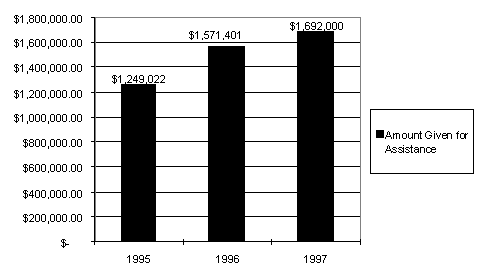
Emergency rent and utility assistance distributed in 1995 by the EAP was $1,249,022. In 1996, assistance increased 25.8% to $1,571,401. In 1997, it increased again to $1,692,000, up 7.7%. Increased requests for emergency assistance may be attributed to rising costs of rent and utilities, increasing poverty rates, lack of affordable housing, rising property values and changes in federal and state welfare laws. The increase in EAP assistance is a positive trend toward meeting demand, and it is exceeding inflation rates. Additionally, community resources, such as Caritas, CEACO and local churches, provide limited funding for rent and utiltities not included in Figure 4.5.2.
Figure 4.5.3
Unduplicated Number of People Receiving Rent and Utility Assistance
FY 1995-1997
Source: Austin/Travis County Emergency Assistance Program.
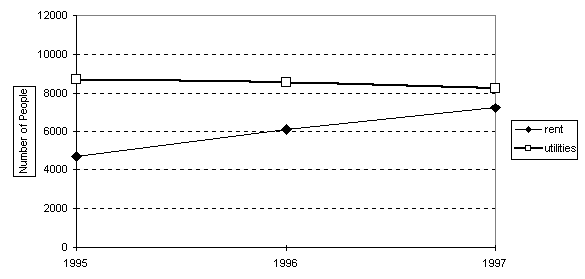
Between 1995 and 1997, the number of individuals receiving rent assistance rose, while the number of individuals receiving utility assistance declined slightly. Typically, rent and utility assistance is provided once a year per client.
Figure 4.5.4
Unduplicated Number of People Receiving
Rent and Utility Assistance in Travis County
1994 |
1995 |
1996 |
1997 |
|
| Rent | 3,200 |
4,673 |
6,098 |
7,190 |
| Utilities | 8,766 |
8,686 |
8,570 |
8,217 |
Source: Austin/Travis County Emergency Assistance Program.
The number of people receiving financial assistance for rent increased 46% in 1995, 30% in 1996, and 18% in 1997.
The number of persons receiving financial assistance for utilities declined a mere 1% in 1995, 1% in 1996, and 4% in 1997. This decline becomes more problematic as an increasing number of landlords in Travis County adopt a policy of evicting renters when utilities are disconnected.
OUTCOME: Increased amount of food produced and/or distributed to persons who need it
Information about food assistance in Travis County is incomplete. The information collected says more about the supply of food available than it does about how many people are in need of food assistance. No unduplicated count of Travis County residents receiving food assistance is available at this time, nor is there concrete information on the number of providers.
Food providers in Travis County collect different types of data, creating difficulties in estimating the amount of food distributed in Travis County. The information collected here provides an incomplete sketch of the level of need and the community’s ability to respond.
Food assistance programs provide emergency food either through pantries (bags of groceries), soup kitchens (prepared meals) or a combination of the two.
The Capital Area Food Bank (CAFB) is the primary pantry supplier for Austin and Travis County, distributing seven million pounds of unprepared, unprocessed food to more than 150 agencies in 1997. Salvation Army, Caritas and Austin Baptist Chapel are three examples of agencies that purchase food from CAFB.
The Salvation Army serves approximately 550 prepared meals every day, or 16,000 meals in one month. They provide groceries to three households/10 individuals per day. Caritas serves approximately 222 meals per day, or 4,551 per month, and provides groceries to 16 households/45 individuals per day. The Austin Baptist Chapel provides approximately 200 meals per day and also runs a food pantry. A survey of 36 church food pantries in Austin found that these churches provided groceries to approximately 450 households/940 individuals per day. These providers report greater usage of kitchens and pantries between November and February, and during holidays (Thanksgiving, Christmas). Finally, Meals on Wheels and More prepares and delivers an average of 1,450 lunches five days per week to the elderly and homebound.
Travis County operates seven food pantries -- five rural and two urban. These food banks provided 2,427 food vouchers to individuals and families during FY 97-98 and provided groceries to 3,275 households/9,214 individuals this year. The City of Austin has established food banks in some of the neighborhood centers around town.
Figure 4.5.5
People Receiving Food in Travis County
1998
Prepared Meals Provided Directly to Clients |
Population Fed |
Number of Households Fed per day |
Number of Individuals Fed per day |
| Meals on Wheels | Elderly/Homebound |
1,450 |
1,450 |
| Salvation Army | General Public |
550 |
550 |
| Austin Baptist Chapel | General Public |
200 |
200 |
| Caritas | General Public |
222 |
222 |
| Total Providers | All |
2,422 |
2,422 |
There is very little data available on the amount of clothing distributed in Austin and Travis County. However, according to a 1998 capacity survey conducted by the Community Action Network, there are at least 43,900 people receiving clothes from 36 agencies in the Austin area.
OUTCOME: Increased access to transportation for work and training
Figure 4.5.6
Capital Metro Passes Distributed in Austin 1997
Type of Pass |
Requested |
Issued |
Demand Met |
| Adult | 1,932 |
960 |
49.7% |
| Student | 999 |
340 |
34.0% |
| Express Adult | 205 |
90 |
43.9% |
| Special Transit Services (STS) | 405 |
100 |
24.7% |
| 10-Ride STS | 381 |
100 |
26.2% |
| 20-Ride Book | 906 |
510 |
56.3% |
Source: Capital Metro, FY 1997.
Figure 4.5.6 demonstrates that demand for transportation assistance is lagging far behind what is currently available. In all but one category, passes made available by Capital Metro are meeting less than 50% of the demand. The number of passes distributed by the local transit authority has remained unchanged for several years. However, many agencies use program funds to purchase transportation passes.
Goodwill Industries, Austin Rehabilitation, Texas Rehabilitation Commission and several other agencies coordinate with the Capital Metro Special Transport Services (STS) to arrange transportation for persons with mobility impairments.
OUTCOME: Increased number of affordable child and adult daycare slots
Child care is generally considered affordable when it consumes no more than 10% of a family’s income.
In March 1998, 2,200 children were in subsidized care provided by the Child Care Management System program. That same month, there were 2,000 on the waiting list to receive care.
The most recent child care tuition information is based on the Austin/Travis County Child Care, Benefits, and Tuition Survey. Median and average costs for Travis County are presented below.
Figure 4.5.7
Tuition Costs for Full-Time and Part-Time Child Care
| Full-time Programs | Estimated Median Annual |
Estimated Average Annual |
Monthly Median |
Monthly Average |
| Infants | $5,820 |
$6,072 |
$485.00 |
$506.00 |
| Toddlers | $4,980 |
$5,172 |
$415.00 |
$431.00 |
| Preschoolers | $4,500 |
$4,656 |
$375.00 |
$388.00 |
| School-age | $1,920 |
$2,064 |
$160.00 |
$172.00 |
| Part-time Programs | Median Hourly |
Average Hourly |
||
| Infants | $3.88 |
$4.23 |
||
| Toddlers | $3.39 |
$3.90 |
||
| Preschoolers | $3.06 |
$3.02 |
||
| School-age | N/A |
N/A |
Source: Austin/Travis County Child Care Salary, Benefits and Tuition Survey Summary, December 1997.
Applying the information from Figure 4.5.7, a single mother with two children living at or below 100% of the Federal Poverty Income Guidlines (FPIG annual income of $13,650) with a toddler in child care will spend an average of 38% of her income on child care. The same family living at or below 200% of FPIG (annual income of $27,300) will spend an average of 19% of their income on child care. The fact that the primary subsidized child care agency in Travis County has a waiting list of some 2,000 indicates that there is not adequate affordable child care available in our community.
There is a need for better data on the demand, availability and cost of affordable adult daycare. The 1997 estimated population of individuals in Travis County between the ages of 65 and 74 was 28,515. The number older than 75 was 21,531. The 1998 Social Service Contracts funded by the City of Austin and Travis County included one adult daycare program that cares for persons with Alzheimers.
Both the Community Action Network’s Community Guide and issue area experts identified additional outcomes related to basic needs. These outcomes are listed below with annotations indicating the need for clarification and data in order to assess the current situation in the community.
The following outcomes are overly complex or ambiguous and require additional consideration by the Community Action Network:
The following outcomes are measureable but do not have data available, or the data are inadequate: